ATSF FP45 96 |
|---|
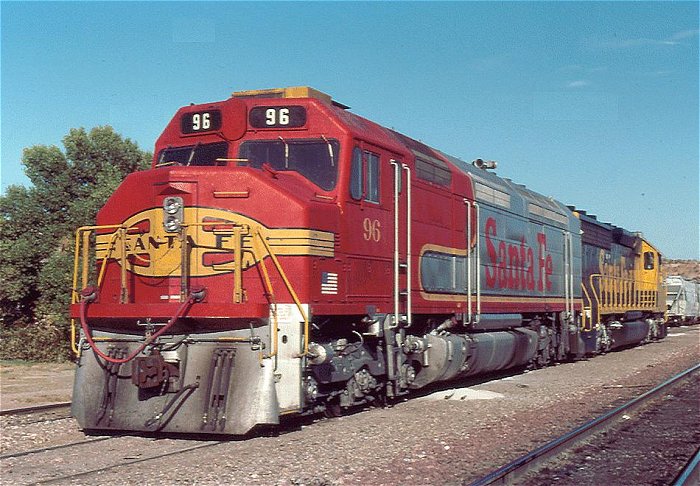 |
| Photo by Bill Morrison |
ATSF FP45 96 |
|---|
|
| Photo by Bill Morrison |
History | |
|---|---|
 |
Santa Fe FP45 96 was built as Santa Fe 106 in December 1967. Less than two months later, an unknown photographer found the gleaming unit sitting at Barstow, CA nose-to-nose with a soon-to-be-retired Alco PA-1. Photo courtesy the Western Railway Museum Archives. |
 |
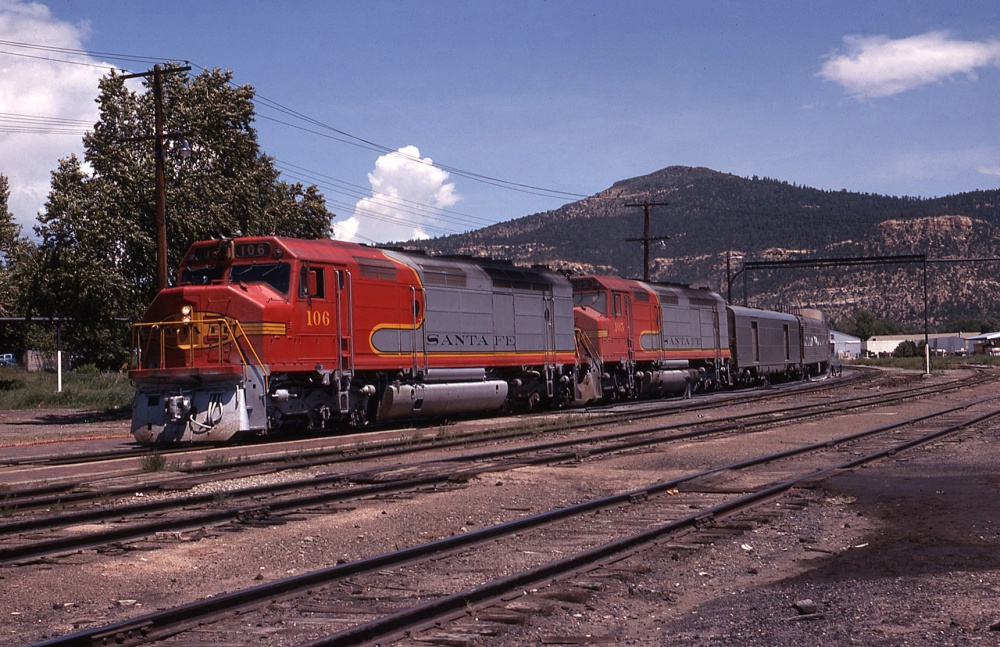
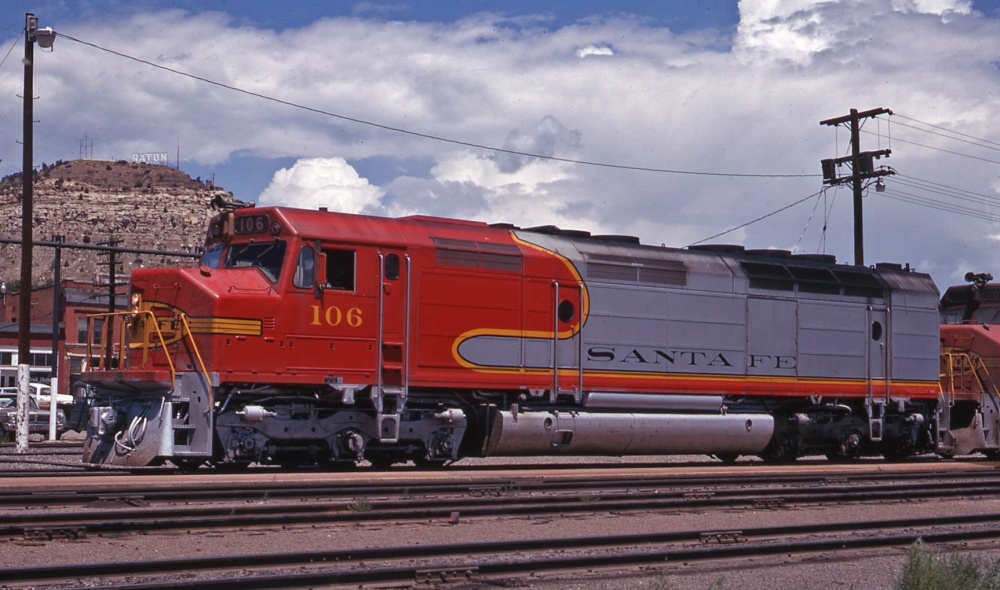
During their first two years on the roster, the FP45's were frequently used in pairs on Santa Fe's extra-fare Chicago - Los Angeles passenger trains: the all-Pullman Super Chief and all-chair El Capitan. By the late 1960's these trains were usually combined into one except during the summer months. The top photo by Dudley Westler shows 106 and 108 on the point of #17, the combined Super Chief/El Capitan, at Albuquerque, NM on October 13, 1968, while the lower two by Vincent J. Porreca show 106 and 105 westbound with 2nd #17, just the El Capitan, at Raton, NM on July 14, 1969. Note the aluminum-painted Leslie S-3L air horn on the cab roof. |
 | |
 | |
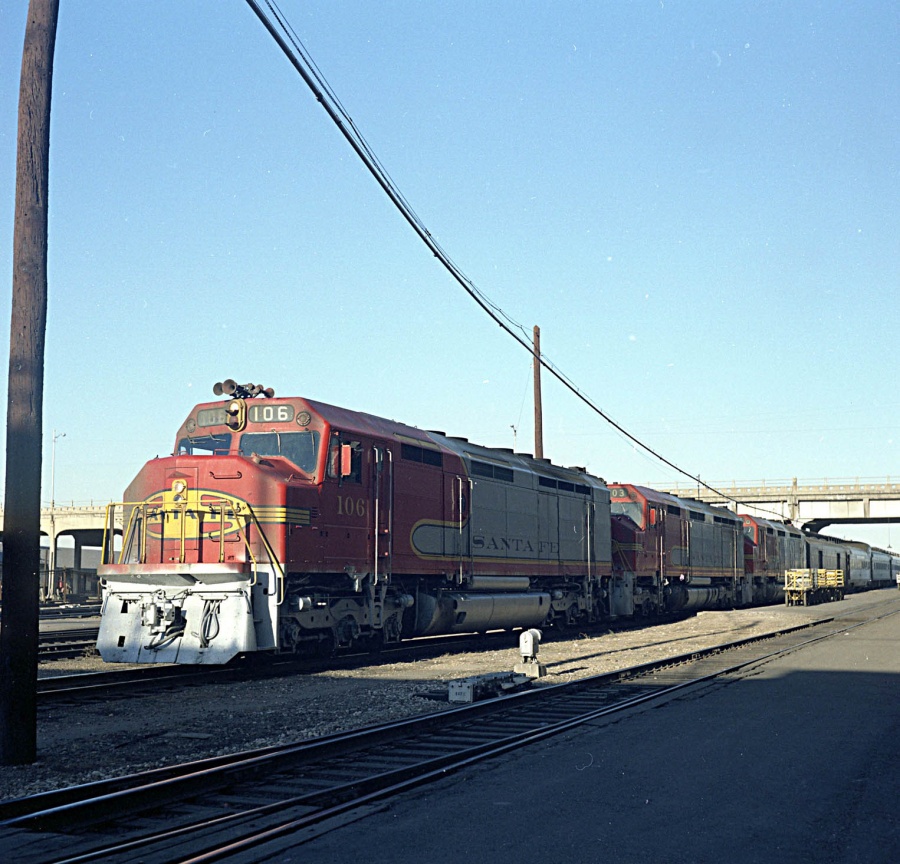 |
In the late 1960's, Santa Fe passenger service to Denver, CO consisted of a short train that ran south down the Joint Line to meet the Super Chief at La Junta. On November 29, 1969 the Super itself paid an unexpected call on the Mile High City when a derailment in Arizona prompted a reroute over the Union Pacific. From Denver, the train proceeded south to La Junta and then east on its normal route. Power for the detouring train consisted of 106, 103, and another unidentified FP45. With only 9 FP45's on the roster, three on one Super Chief was a real rarity, but it happened at least this once. By this date, 106 had traded its three-chime horn for a five-chime Leslie S-5T, Santa Fe's most common "passenger" horn. Photo by John Tudek from the collection of E.D. Motis. |
 |
The 106 was renumbered 5946 in March 1970 as part of the 1969/70 general renumbering. Following its reassignment to freight duties with the coming of Amtrak in 1971, it traded its red and silver warbonnet colors for the blue with yellow details scheme in late 1971 or early 1972. Within a few years, it was repainted into the blue and yellow warbonnet scheme. Bob Finan caught the unit leading an F45 in the older scheme through Torrance, CA on its way to Watson Yard in Wilmington, CA. |
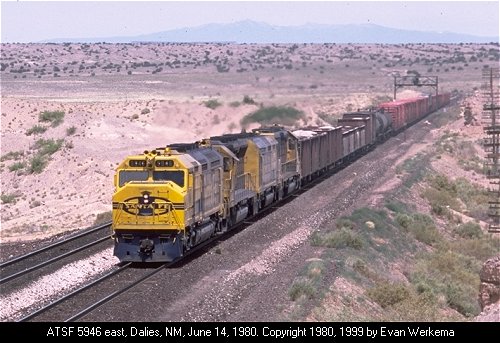 |
The photo at left shows 5946 leading an eastbound Santa Fe freight west of Dalies, NM in 1980. Note that the unit still has a Gyralite between the numberboards, a feature left over from its days as a passenger engine. |
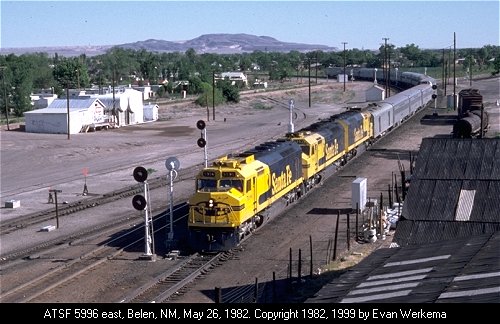 |
In January 1982, 5946 was rebuilt at the Santa Fe shops in San Bernardino, CA, emerging as 5996. It was the first rebuilt FP45 to be released with a 5990-class number, as the first two rebuilds, 5943 and 5945, kept their 5940-class numbers until early 1982. The first three rebuilt FP45's are shown as they team up on a directors' special in May 1982. The 5996 leads, followed by 5993 and 5995. |
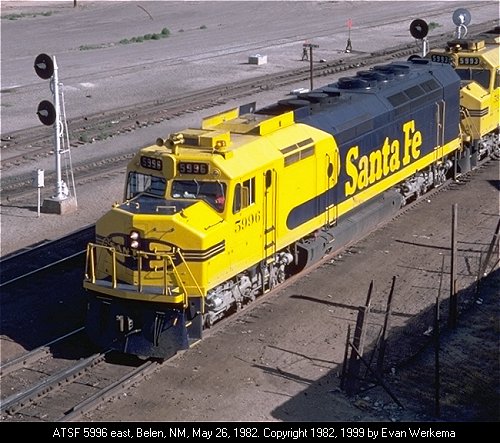 |
A closer view of 5996. Compared with the unrebuilt 5946, a few external changes can be noted. A cab air conditioner has been added, and the Gyralite between the number boards has been removed. The unit also sports smoke deflectors, a feature Santa Fe began adding to rebuilt locomotives in early 1981 in an effort to keep exhaust gasses from entering the air intakes. Santa Fe began removing the deflectors a few years later. |
 |
The reason for the four FP45's on this eastbound at Blue Cut on Cajon Pass in California is not known, but it certainly makes a pretty picture. When a directors' special was in the offing, Santa Fe would "corral" three or four FP45's and keep them in captive service for a few days to make sure the units would be on hand for the special. Photo by Bill Morrison. |
 |
The 5996 was one of seven FP45's repainted in the SPSF red and yellow warbonnet scheme in anticipation of a merger with Southern Pacific in 1986. After the merger was denied by the ICC in July of that year, the FP45's were gradually repainted back to Santa Fe blue and yellow. It is not known whether 5996 made it back to blue and yellow, though, before yet another paint scheme was selected for the FP45's. |
 |
The 5996 was back in blue and yellow by the time Steve Sloan caught it on a train at Walong, CA on Tehachapi Pass in May 1989. It wouldn't be long before the unit was back in the paint booth for the application of yet another paint scheme. |
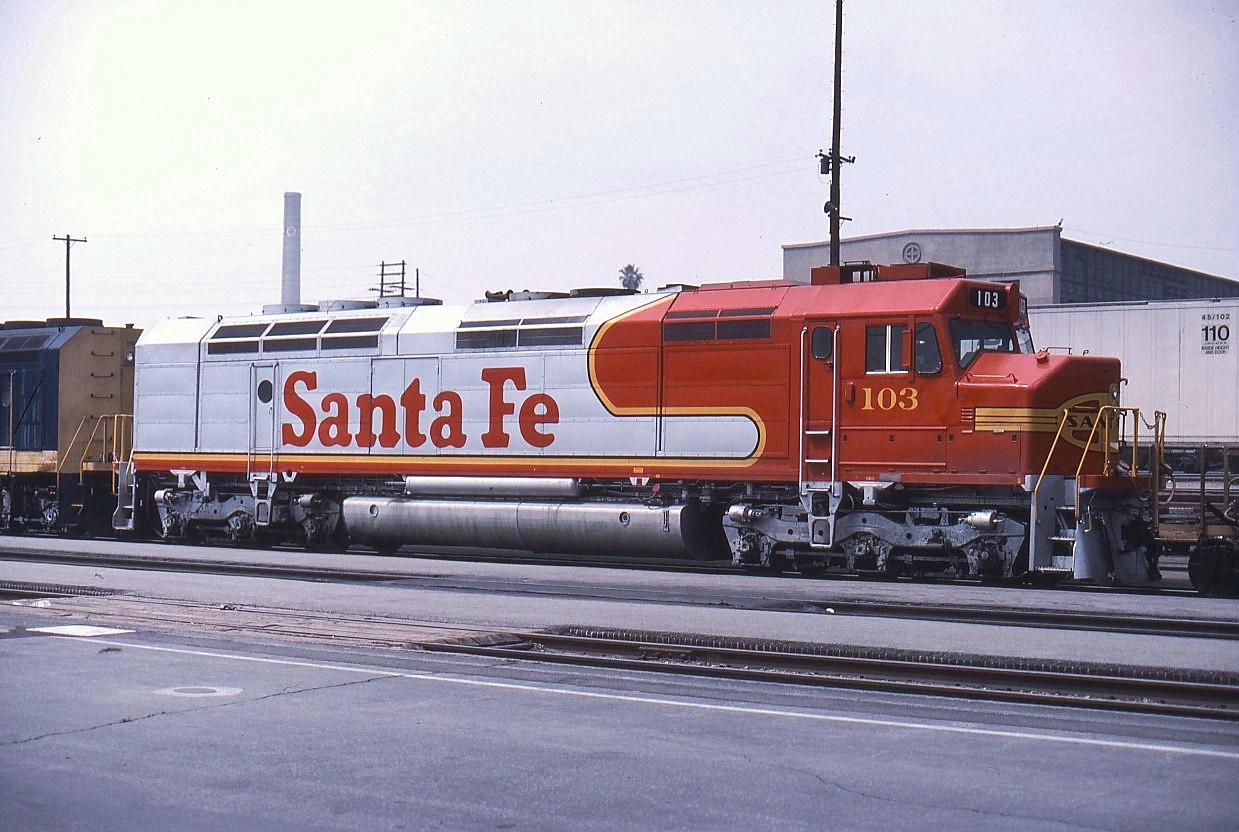 |
Starting in mid-1989, the FP45's were repainted in a variation of the old warbonnet red and silver passenger scheme as part of a marketing plan dubbed "Superfleet." The units were also renumbered into the 100-class, but did not retain their as-built sequence. Instead, they received numbers more or less in the order they came from repainting. The 5996 was the fourth unit repainted, and was numbered 103. Gary Kluge photographed it at San Bernardino, CA on April 14, 1990. |
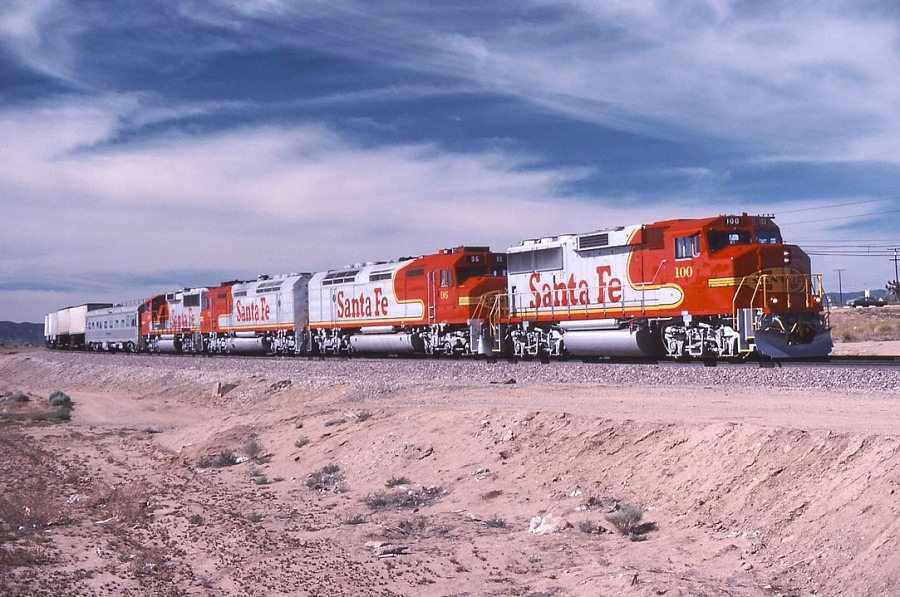 | With the impending arrival of the 100-class GP60M's in May 1990, the FP45's were again renumbered. Most of the units briefly returned to their old 5990-class numbers before receiving 90-class numbers. The 103 was one of two FP45's that was renumbered directly to its new 90-class number: 96. The 101 was the other unit, renumbered to 92. FP45's 96 and 92 accompanied GP60M's 100 and 101 on their inaugural trip west on train Q-NYLA, departing Chicago on May 20, 1990. The Gary Kluge photo at left shows the same power set returning east on May 23rd with train 2-891-23 at Hesperia, CA. Business car Mountainair is behind the power. |
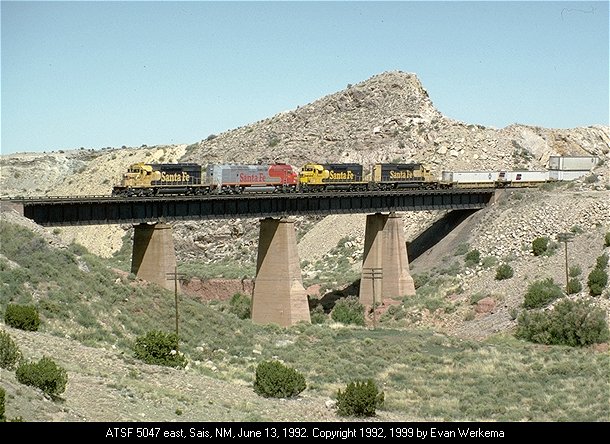 |
As 100-class units, the FP45's were often run in matched sets on priority trains.
After renumbering into the 90-class, they reverted to a more humble status (if more fitting,
given their age) as general freight locomotives. The units usually ran in trailing positions,
as in the view at upper left. The 96 and a trio of SD40-2's lead a stack train eastbound over the
second trestle from the west end of Abo Canyon in New Mexico in June 1992. A few months later, Bill Morrison found the 96 at Victorville, CA on September 27, 1992 awaiting a call to another menial task, helper duty on Cajon Pass. |
| |
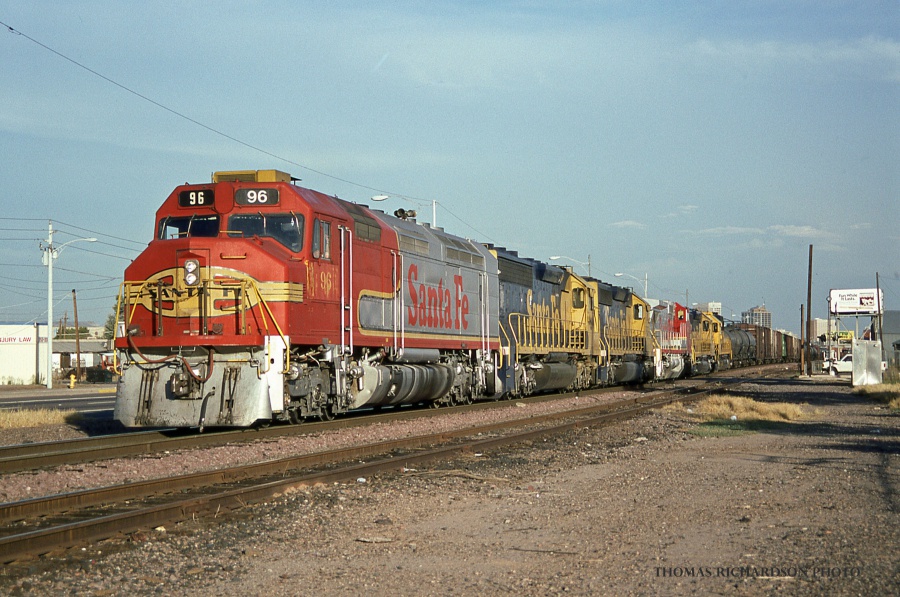 |
The 96 had lost its "Desert Storm" flag and acquired a mismatched set of numberboards by the time Thomas Richardson caught it leaving Mobest Yard in Phoenix, AZ with the evening manifest destined for Belen, NM on July 23, 1994. |
 |
The 96's career ended tragically on Cajon Pass on December 14, 1994, when the westbound freight it was on ran away and rear-ended a stopped UP freight. The crews managed to jump to safety, but six locomotives were destroyed, including FP45 96 and F45 5976 on the Santa Fe train and two UP helper locomotives on the rear of the UP train. Brian Kreimendahl photographed the sad remains of the 96 at the wreck site on December 22, 1994. |
References |
|---|
| 1. EuDaly, Kevin, Santa Fe 1992 Annual, Denver: Hyrail Productions, 1992. |
| 2. McMillan, Joe, Santa Fe's Diesel Fleet, Chatham Publishing Co, 1975. |
| 3. McMillan, Joe, Santa Fe Motive Power, McMillan Publications, 1985. |
| 4. Shine, Joseph, Santa Fe 1987 Motive Power Review, Four Ways West Publishing, 1988. |
| 5. Extra 2200 South Locomotive Newsmagazine, Issue 105. |
Back to Santa Fe Preserved Locomotives