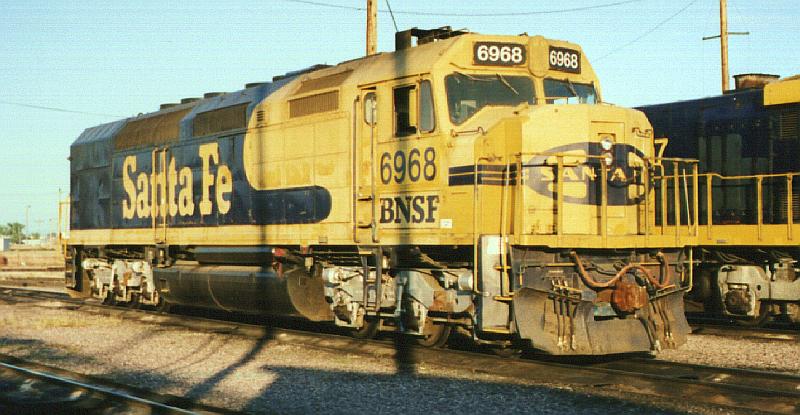
While I was unable to get an exterior shot of the 6969 I was able to go back
into its engine room while stopped in the siding at Benteen.
Ahh... it has
been a while since I've walked INTO an engine room. The dim light. The noise.
The heat. The smell of hot oil and fuel. I took some photos of it and the cab.
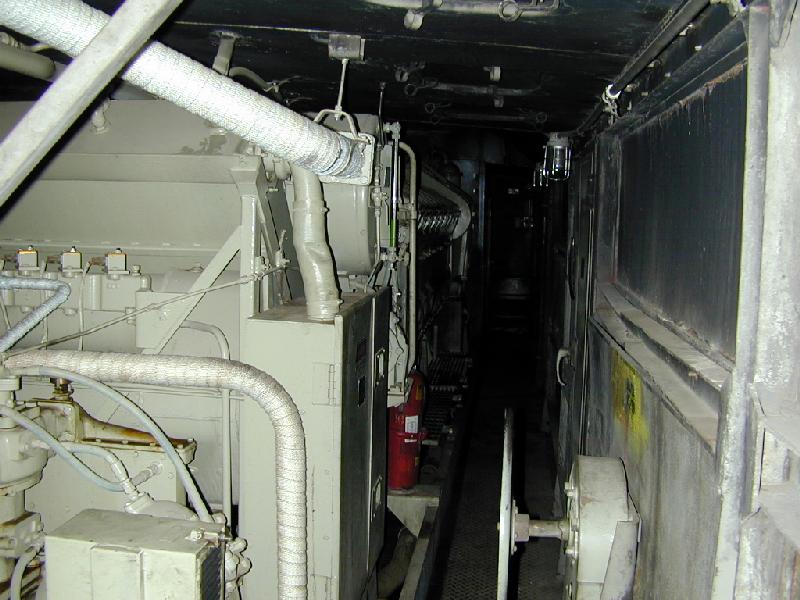
The first picture is looking up along the rightside of the engineroom towards
the door to the cab. The lights are burned out, an FRA defect, so it is very
dark up the walkway. The loco's handbrake wheel is along the righthand wall. Up
the walkway a few steps is a red fire extinguisher mentioned later. In the lower
left of the picture is the air compressor.
Here is a better picture of the 3 cylinder aircompressor. It is water cooled
and shaft driven from the engine. The compressors run all the time the engine is
running. To stop the compressor from pumping air after the main reservoirs are
at the proper pressure the compressor's valves are held open by control air. The
compressors have their own oil system. The small boxes above the compressor are
the thermostat switches that turn each of the 3 radiator fans on at a different
temperature and the radiator shutter control switch. The big thing along the
left edge of the picture is a concrete ballast weight.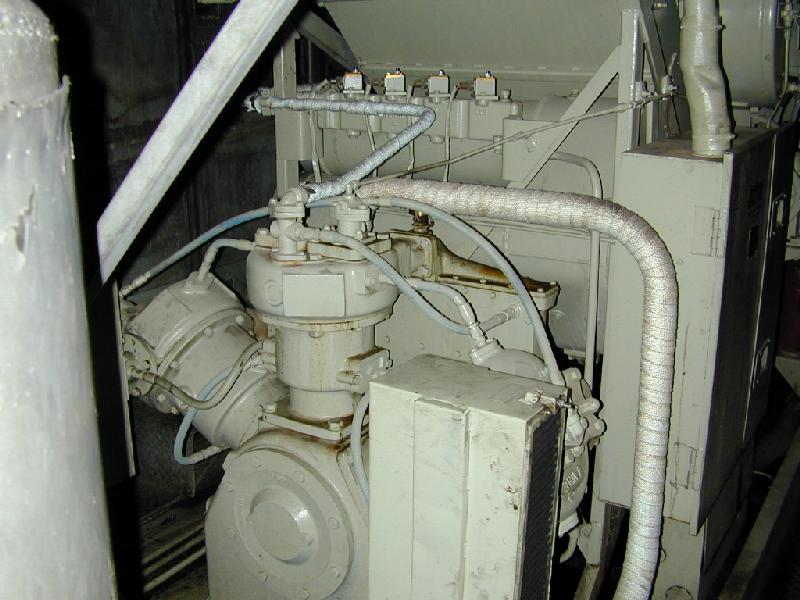
For the next photo I've walked forward up to where the red fire extinguisher
is in a previous shot. We are still looking up the walkway towards the cab.
Our 3600 HP BN F45s had 20 cylinder engines but this 3000 HP SDP40F only has
16 cylinders. You can tell that it has a shorter engine as soon as you step into
the engine room account of all the extra room at the back of the unit. You can
also tell a 20 cylinder from a 16 cylinder by counting the cylinder drain cocks
or the hand hole covers. The cylinder drain cocks are those "pegs" sticking out
from the side of the block just below the valve train cover latches. These cocks
are supposed to be opened before cranking an engine that has been sitting dead
for some time. Water can leak by seals and get into the cylinders as an engine
cools. If you crank an engine with water in the cylinders the piston will push
the water up to the head and a hydraulic lock will occur. That can do major
damage to the engine itself. By opening these cocks the water has a way to
squirt out of the cylinder thus preventing damage. You can count 8 cocks on this
side. There are an equal number on the other side of the block. Thus this is a
16 cylinder engine. The round covers below are hand hole covers that give access
to the inside of the engine itself. The top row are for the airbox area and the
bottom row are for the crankcase. Again there are 8 of each on each side of the
block.
In the very bottom left of the photo you can see two silver buttons.
One is the Low Water button and the other is the Crankcase Over pressure button.
If either one trips its button will pop out a little bit revealing a red ring
around it. To reset it you simply push it back in to latch. When these buttons
trip they in turn trip the Low Oil shut down on the governor which stops the
engine. So you also have to reset the Low Oil button which is located on the
backside of the governor itself. Because of the danger of a crankcase explosion,
the rules prohibit crewman resetting the Crankcase Over Pressure if it
trips.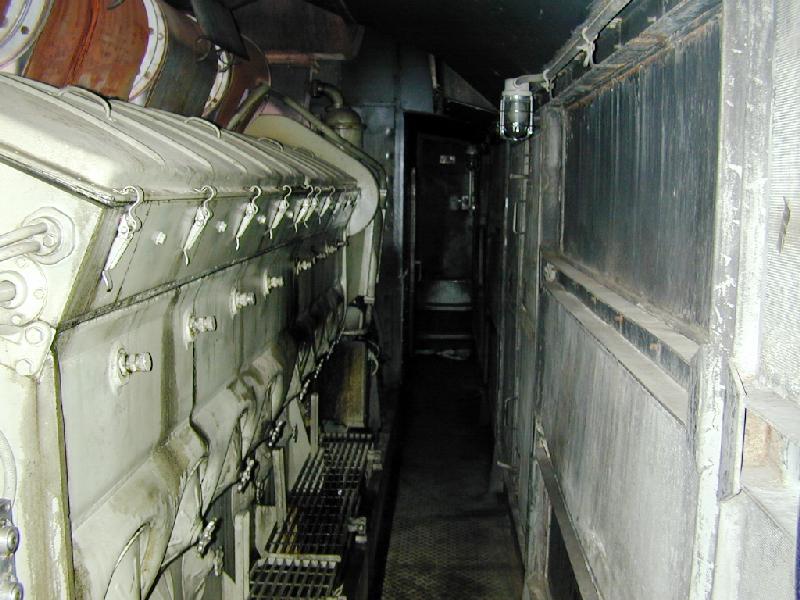
While standing at the same location as above I turned to the left and took
the next picture of the accessory end of the unit's EMD 645 prime mover.
It
shows the governor and the linkages to the layshafts which control the fuel
injector settings. The vertical lever at the lower righthand corner of the photo
is the layshaft handle. By pushing on this lever you can manually rev up the
diesel engine. It is sometimes necessary to push in a little bit on it when
starting the engine to give it a bit more fuel while cranking.
The governors
have their own separate oil supply. You can see a small oil sight glass mounted
on the governor that is used to check the level of this oil.
The two hoses
coming from the governor that run towards the left edge of the photo are the oil
lines to the load regulator. The governor controls the electrical output of the
main traction alternator by hydraulically controlling the load regulator. (Shown
later).
The other hoses coming from the governor go to engine protective
devices such as Low Water shut down, crankcase Over Pressure shut down, and Low
Oil pressure shut down.
The two circular devices below the governor on
either side are the engine's water pumps.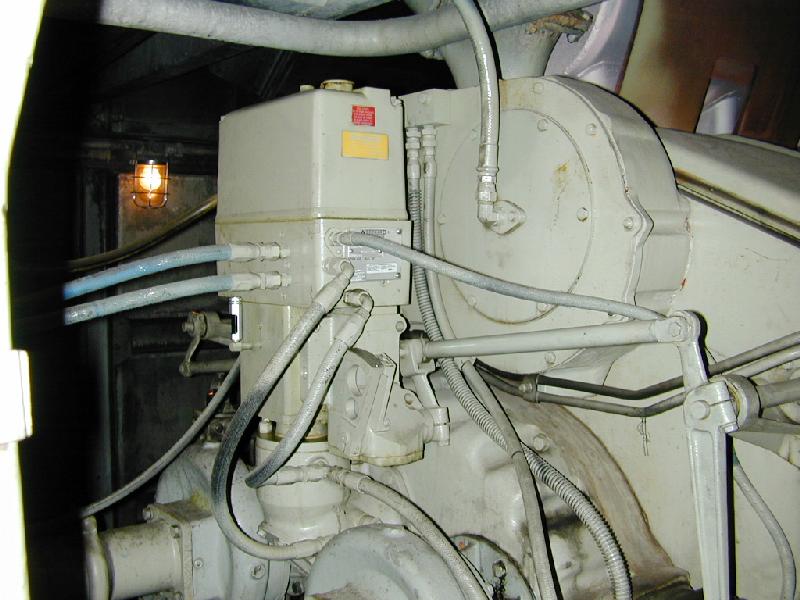
Taking a few more steps forward up the walkway and then turning around to
look back in the direction from which we came you see the view of the next
photo.
You can see the same handbrake wheel as before. In the distance in
the darkness you can see the large verticle cylinder of concrete that is used as
weight to ballast the locomotive. When these units were in passenger service for
Amtrak they would have had a steam boiler in the dark rear section seen in this
view.
The horizontal cylindrical object up at eye level is the water
expansion tank for the diesel engine's cooling water. You can see a vertical
water sight glass tube mounted on the end of the tank. It is about 1/3 full of
green water. The water is green because it is treated with corrosion inhibitors.
The water in some units is pink. The silver cap up on the side of the tank is
the water fill.
Below the water sight glass, the circular thing with the
dark window in it is the load regulator. This is a large potentiometer.
(rheostat). The lighter colored thing at a 45 degree angle, inside behind the
window, is the wiper arm of the potentiometer. The position of this wiper arm is
hydraulically controlled by the governor to regulate the electrical output of
the main traction alternator.
Above and to the right of the load regulator
is the engine oil pressure guage. Below and to the right of that is the engine
water temperature guage. Below and to the left of that is the engine start
switch. Near the lower righthand corner of the photo are the two silver colored
Low Water and Crankcase Over Pressure buttons mentioned in another
photo.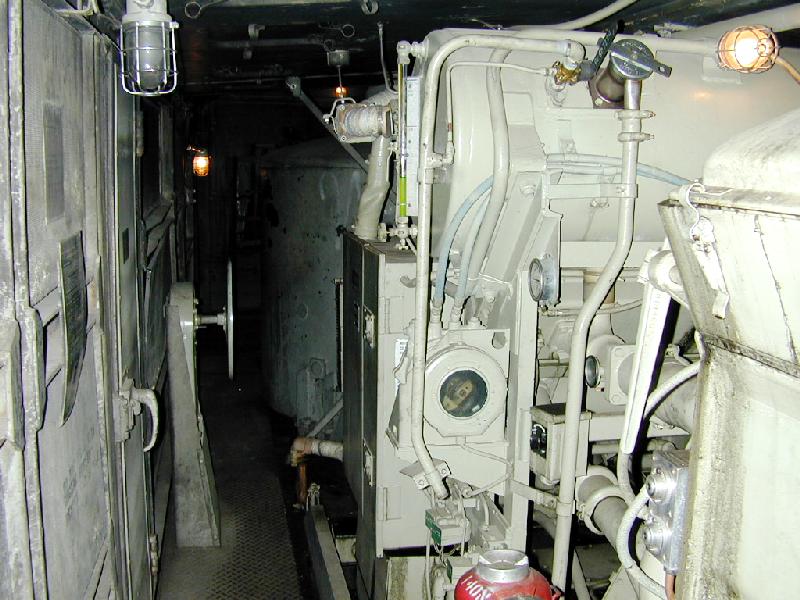
Backing up about 20 feet and looking the same direction as the previous photo
we get this view along the engine. The "rusty barrels" on top the engine is the
exhaust manifold.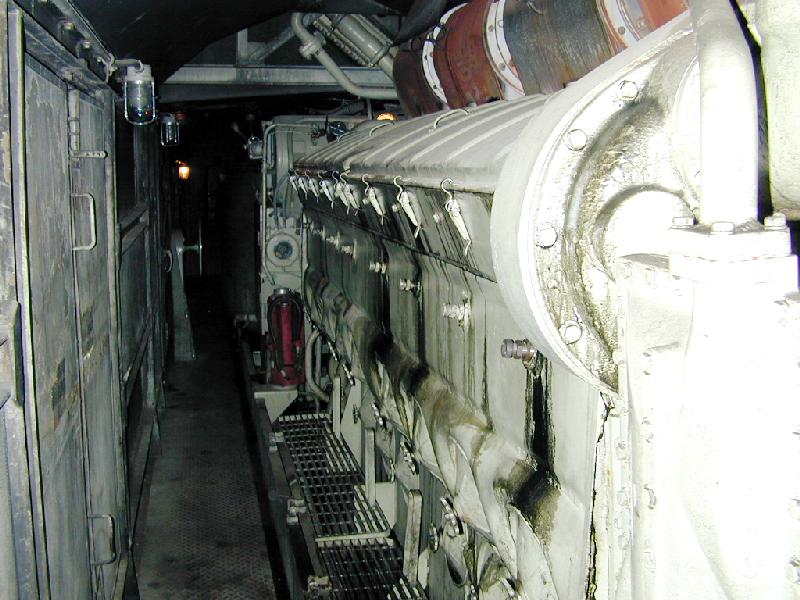
In the above photo
if I were to turn 90 degrees to my right I would see the turbocharger. Below
that would be the large main traction alternator. Unfortunately you are too
close to them to get any meaningful pictures.
About ten feet or so behind my
location in the photo above is the door into the cab. Open it and climb in on
page two.
| Go to Al Krug's previous Tales | Al Krug's Home Page | E-Mail Al Krug |