Airchime K2H | ||
|---|---|---|
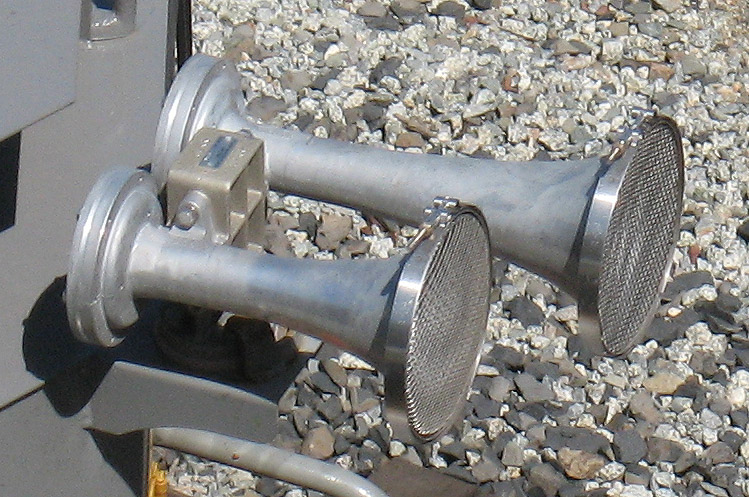 | ||
The K2H uses K-bells 1 and 2 attached to the sides of a special narrow manifold. This particular horn is fitted with optional screens over the bells to keep debris from fouling the horn. | ||
 | The 1975 Nathan Airchime catalog lists the K2H as a "standard 2-tone locomotive whistle as supplied on export locomotives." Not many have apparently been supplied for use on domestic US locomotives. One early domestic use of the two-chime K-manifold was on Amtrak SDP40F's, which began to trade their Leslie SL4T horns for K5LA's when the latter became available in 1975. On the second order of SDP40F's, the SL4T horn had been split over two manifolds for lower clearance, and the replacement K5LA's were likewise split, using a standard low profile 3-chime manifold and the K2H 2-chime manifold. Photo courtesy Ed Kaspriske. | |
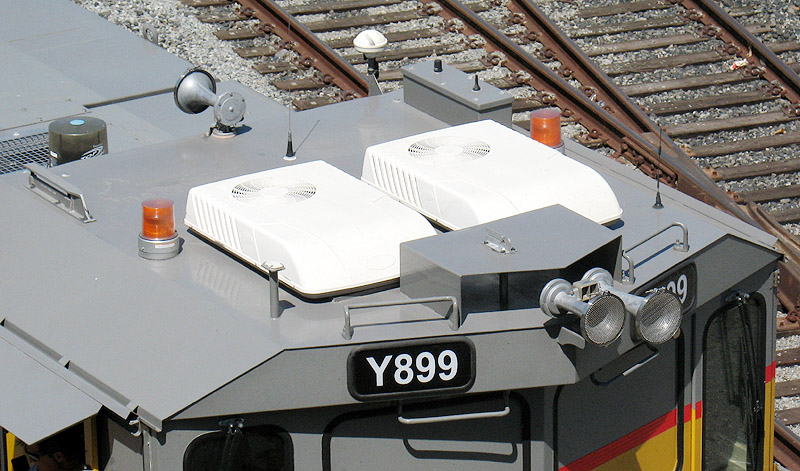
 | Some Railpower RP20BD and RP20CD genset locomotives have a K2H mounted in front of the cab in combination with a separate KS2 mounted on the rear of the cab as shown the third photo below.Not all Railpower gensets use this arrangement; many are fitted with a single K3LA instead. | |
 | ||
 | ||
 | Los Angeles-area commuter railroad Metrolink's Guardian-fleet cab cars have K2H horns using the #2 and 4 bells. The horns are mounted under the floor and behind the pilot to try to direct the sound down the tracks and minimize noise complaints from surrounding neighborhoods. | |
The K2H with bells 1 and 2 plays D# and F#, a minor 3rd interval. | ||
K2H sound samples:None available at this time. | ||
Other K2 horns | ||
 | San Francisco Peninsula commuter railroad
Caltrain originally fitted its F40PH-2 locomotives with 5-chime K5LA horns.
The railroad moved the horns from the cab roof to a spot near the middle of the locomotive in the
late 1990's. In 2001, bowing to noise complaints from neighborhoods near the tracks, it replaced the
K5's with P2 horns as the primary horn. The railroad left the K5 manifold in
place on the locomotive roof, removed the 1, 4a, and 5 bells, and reversed the 2 and 3a bells to use
as a backup horn. These ersatz K2's were seldom heard until July 2009, when issues with the P2's prompted the railroad to temporarily turn the bells on the K2's forward and make them the primary horn. The 2 and 3a bells play F# and G#, a major 2nd interval and probably the least pleasing 2-note combination available from the five notes that comprised the K5LA. The horns lasted only a few months before the P2's returned as the primary horn.
 | |
"Caltrain K2" sound samples:Sample 1...386kB...24 secondsSample 2...97kB...6 seconds Sample 3...65kB...4 seconds Sample 4...371kB...24 seconds | ||