Nathan M5 | |
|---|---|
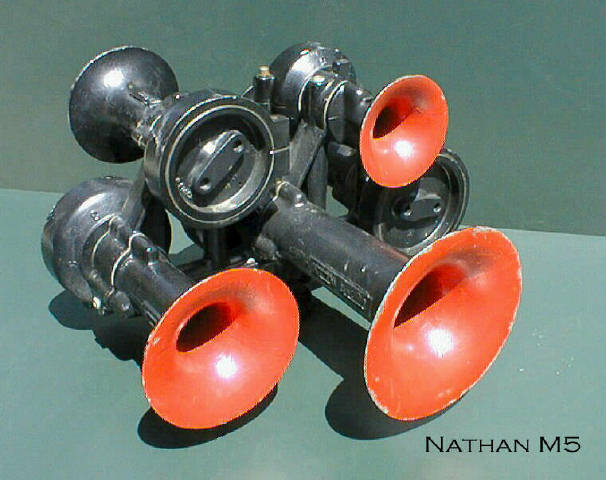 | |
| The picture illustrates a common arrangement of the horn bells with the #2 and #4 bells reversed
(turned backward). In this configuration, the horn is designated an M5R24. Other Views (click for larger image): | |
 | Side view of the M5R24 |
 | The M5 was first produced in 1950 as a refinement of the H-5. Gone were the external copper tubes supplying air to each bell, replaced by a more substantial manifold. The placement of the bells and design of the back caps were also different. The chord and the beautiful timbre remained, however.The first M5's made in 1950 looked like the one at left. The horn bells are perfectly round where they meet the manifold (or base). Subsequent refinements in 1951 resulted in so-called "scallop base" horns such as the one at the top of the page. Horn and photo courtesy Brent Lee. |
 | The M5 was the common horn on the Western Pacific, Southern, Atlantic Coast Line, Seaboard Air Line, Richmond Fredricksburg & Potomac, Baltimore & Ohio, Chesapeake & Ohio, and other eastern railroads. Southern Pacific had M5's on many of their passenger service locomotives. The Western Maryland Railroad had pairs of M5's on many of their cab units.No railroads are known to have purchased M5's in recent years, but they can still be purchased new...for a price. The horn pictured at left was bought new from Nathan in 1999. Horn and photo courtesy Brent Lee. |
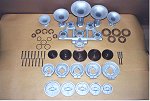 | Here's what an old, round-base M5 looks like when it has been almost completely disassembled. Note how the power chambers and diaphragms are different sizes for each bell. This was a liability for the M-series horns, as it required the railroads to stock many different sizes of diaphragms. On later horns such as the P-series, all horn bells used identical power chambers and diaphragms. Click on the picture to learn the names of the parts. Horn and photo courtesy Dennis McCurry. |
Original tuning was: A major dominant 7th (C#,E,G,A,C#). | |
The M-series horns turned out to be relatively high-maintenance items,
and with the development of lower-maintenance horns from both Nathan and Leslie, the M's
fell out of favor. Few if any railroads have acquired new M5's since the early 1980's.
There are virtually no M5's in regular use on major freight railroads, but some can still
be heard on excursion and tourist railroads and a handful of shortlines. | |
M5 sound samples:Western Pacific GP40:Sample 1...211kB...9 seconds Simpson Lumber SW1200 (horn courtesy 5CC): Sample 1...437kB...20 seconds Sample 2...247kB...11 seconds Oakland Terminal GP7 (horn courtesy 5CC): Sample 1...332kB...5 seconds Sample 2...332kB...10 seconds Sample 3...232kB...10 seconds Niles Canyon Railway, various locomotives (horns courtesy 5CC): Sample 1...281kB...13 seconds Sample 2...135kB...6 seconds Sample 3...207kB...9 seconds Sample 4...239kB...11 seconds Sample 5...319kB...14 seconds Sample 6...544kB...25 seconds Sample 1...65kB...3 seconds Sample 2...310kB...14 seconds Sample 3...177kB...8 seconds Same horn two years later: Sample 4...270kB...12 seconds Sample 5...119kB...5 seconds Same horn a year later: Sample 6...453kB...21 seconds Sample 7...200kB...9 seconds Sample 8...173kB...8 seconds New Georgia (ex-Southern) EMD FP7: Sample 1...221kB...10 seconds Sample 2...373kB...17 seconds Southern Pacific H24-66 "Trainmaster:" Sample 1...135kB...6 seconds Sample 2...216kB...10 seconds Sample 3...65kB...3 seconds Sample 4...245kB...5 seconds Sample 5...173kB...3 seconds Southern Pacific, others: Sample 1...340kB...15 seconds Sample 2...151kB...6 seconds | |