AirChime K5HL | |||||||||
|---|---|---|---|---|---|---|---|---|---|
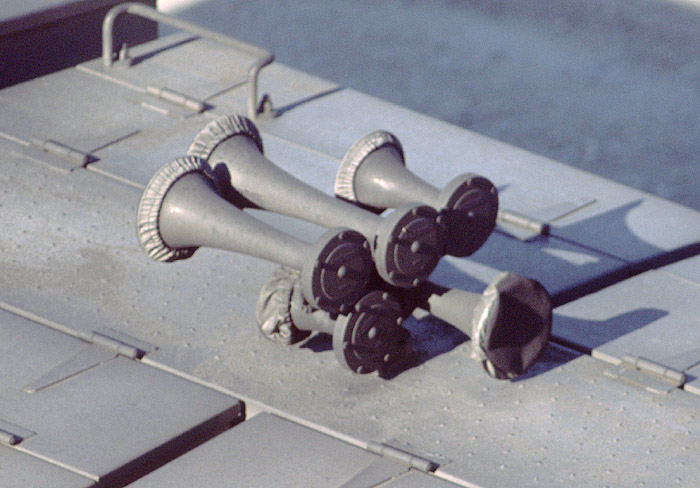 | |||||||||
The picture illustrates a common arrangement of the horn bells, with the #2
bell reversed. In this configuration, the horn would be designated a K5HLR2. The "H" indicates the use of a
high-profile manifold, and the L indicates the use of the 1L bell replacing the 5 bell of the
standard K5H. | |||||||||
 |
The US Code of Federal Regulations has long specified a minimum
decibel requirement for the "audible warning device" on railroad locomotives:
96dB(A) at 100 feet forward of the locomotive in its direction of travel
(49CFR229.129). Effective December 18, 2004, the regulation also began to specify a maximum
volume of 110dB(A) at 100 feet. Contemporaneously, and apparently in response to this regulation, AirChime began producing 5-chime K
horns for US locomotives that made use of the low-pitched 1L bell, which plays C (261Hz).
 K5HL horns installed on Union Pacific and BNSF GE locomotives have generally
been mounted backwards, with the 3 bell facing forward and the 1L, 1, 2, and
4 bells facing the exhaust stack. This UP horn, and the one at the top of the page, wear UP's
standard "shower caps" over the bells to keep foreign matter out.
Intended tuning is: C,D#,F#,A#,C (261, 311, 370, 470, 512 Hz) | K5HL horns began appearing on new General Electric locomotives in late 2004.
| "old" K5HL sound samples:UP and BNSF ES44AC and ES44DC:Sample 1...312kB...19 seconds Sample 2...387kB...24 seconds Sample 3...266kB...17 seconds "new" K5HL sound samples:BNSF ES44C4:Sample 1...308kB...19 seconds Sample 2...264kB...16 seconds Sample 3...186kB...11 seconds Sample 4...140kB...8 seconds | ||||||